Prostokvasha
Showing posts with label on being. Show all posts

[18 May, 2014]

on healing.2

0 sighs or salutations

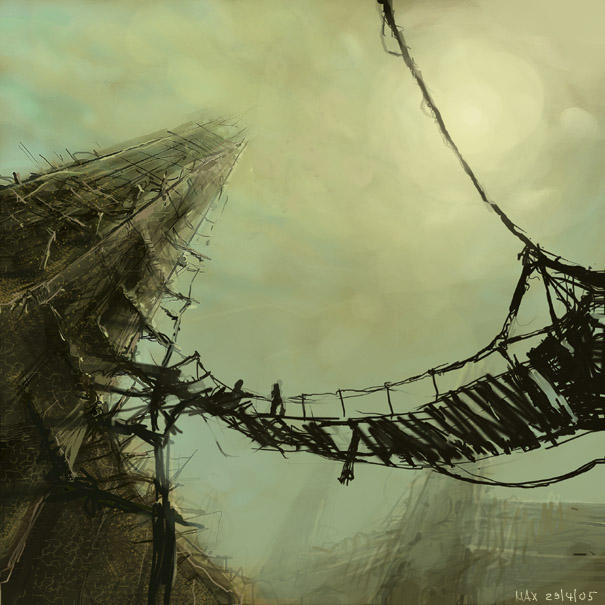
This fable--the person on the bridge specifically--pretty much describes the prison of my childhood, and I guess adulthood, until I learn to let go of the rope. But it's not easy. It continues to be heartbreaking and guilt-ridden. I know that it's not fair to be shackled to someone else's happiness, to be responsible for their life and feelings. And I also know the following statement is not necessarily true, but it feels very real: that I can't be happy until they are happy through my own efforts of making them happy. So that's the big question, I think, can I still be happy even if they're unhappy when I stop making them happy?

Theoretically, standing up for our own needs should create safety and peace of mind. Technically, we simply cannot do more to help others than they are willing to do for themselves. But imagine being that person on the bridge, making the choice, ultimately, to cut the rope even if it means killing the person on the other end. Making the choice of freedom and, in some sense, of murder or death. Can the person on the bridge heal from that heart-wrenching choice? Can the person on the bridge live a guilt-free and peaceful life, moving toward their original goal and accomplishing what they've set out to do? Will I need to mourn the absence, unhappiness, symbolic or otherwise death of the person on the other end of the rope in order to move on from the bridge?

I wish I had the social support to deal with all of these changes. I think social isolation and shame are part of the experience for the person on the bridge. There are no bystanders, or the bystanders misunderstand the situation and perpetuate the person holding on to the rope. "Just keep holding on," they shout. "They'll perish without you. You are all they have. Keep holding on!"

The loneliness, the guilt, the sadness and heartbreak are all part of this story.

[03 May, 2014]

on healing

0 sighs or salutations

I keep meaning to document my journey from experiencing life as a dark brooding storm that can overtake me at any moment to something more pleasant, perhaps as a challenging yet exciting hike through beautiful woods.

One step toward healing has been in labeling certain childhood experiences as trauma. Straight up, no guilt-strings attached, no taking care of other people's feelings but searching the depths of my own emotions, trauma.

I thought that I was just a pessimistic, maybe a little bit sad, maybe a little bit angry, and lot lonely kind of person. I thought I just had a despairing disposition. I thought I was just sensitive and reacting strongly to many of life's challenges. Turns out, I have been experiencing prolonged post-traumatic stress.

Lifted straight out of the diagnostic criteria, my experiences have included:

  • Somewhat: "recurrent, involuntary, and intrusive distressing memories of the traumatic event"
  • Pretty much: "dissociative reactions (e.g., flashbacks) in which the individual feels or acts as if the traumatic event were recurring"
  • Definitely: "intense or prolonged psychological distress at exposure to internal or external cues that symbolize or resemble an aspect of the traumatic event"
  • Definitely: "marked physiological reactions to internal or external cues that symbolize or resemble an aspect of the traumatic event"
  • Definitely: "avoidance of or efforts to avoid distressing memories, thoughts, or feelings about or closely associated with the traumatic event"
  • Definitely: "avoidance of or efforts to avoid external reminders (people, places, conversations, activities, objects, situations) that arouse distressing memories, thoughts, or feelings about or closely associated with the traumatic event"
  • Definitely: "persistent and exaggerated negative beliefs or expectations about oneself, others, or the world (e.g., 'The world is completely dangerous,' 'My whole nervous system is permanently ruined')"
  • Definitely: "persistent, distorted cognitions about the cause or consequences of the traumatic event that lead the individual to blame him/herself or others"
  • Definitely: "persistent negative emotional state (e.g., fear, anger, guilt, shame)"
  • Somewhat: "feelings of detachment or estrangement from others"
  • A little: "persistent inability to experience positive emotions (e.g., inability to experience happiness, satisfaction, or loving feelings)
  • Pretty much: "irritable behavior and angry outbursts (with little or no provocation) typically expressed as verbal or physical aggression toward people or objects"
  • A little: "hypervigilance and exaggerated startle response"
The list may be overwhelming, but it feels good to point my finger and say, I haven't been crazy or overacting. I have been a victim, I suffered, and in many ways, continue to suffer. But I also actually look forward to leaving many of these experiences in the past now, and rebuilding my private, emotional life in the way I want and deserve for it to be. Setting boundaries around myself and saying that I deserve to live without emotional violence has been one huge step.

No one will live my life for me. My life is exclusively mine; I can do with it whatever I want. And now, finally, I will. I know that I deserve to be free of residual emotional turmoil and I know that I will be.

[15 January, 2012]

on being a therapist

0 sighs or salutations

Therapy is a mysterious process. Something unique happens when two souls meet in a circumscribed safe space. They affect each other in ways that are hard to describe to the outside world. Many people wonder what makes therapy special and what exactly produces results. When people hear about my training, they start asking me questions, or they make comments about therapy that are wrought with their own assumptions. Usually it's people who haven't experienced therapy for themselves.

I've been thinking about my answers to some of these common questions or comments, so here are my attempts to clear up some misconceptions:

Therapists get paid to be supportive and automatically like the people they work with.
Ethical therapists don't lie to their clients, ever. Sure, we receive some training on how to evade certain questions we feel would be harmful to answer, and we don't disclose too much personal information. But other than that, everything we say is truly what we think and how we feel. We are genuinely amazed by people, their survival and their abilities. We don't love our clients blindly and automatically, without any consideration of who they are, just because it's our job. We don't even necessarily love all aspects of our clients all the time. There are usually things we don't like as well, and when the time is right and the relationship is strong enough, your therapist will probably point those out. But therapy wouldn't be what it is if we didn't find beauty in all of our clients' souls. People, in their struggles, in their vulnerabilities, in pain, in perseverance, are pretty amazing. And this includes every person I have worked with up to now and will work with in the future.

What's the point of therapy; can't you just complain to your friends?
Therapy and friendship are similar and different. Both therapists and friends see people during painful and vulnerable points in their lives, and both like those people despite their faults and mistakes. However, therapists are trained to listen with a different ear. They open up a door in their hearts and take on pieces of people's struggles. Therapists listen to their clients, and they listen to themselves. Therapists listen to the tone in the room. Therapists listen for patterns, for significant motifs, for contexts. Therapists don't even really have any stakes in what you say; they just care about what it means to you. They care about how you're feeling now, and how you felt then. They care about your process through tough times, and they rejoice with you in happy times. So the next time you have an issue that you can't talk to your friends about or a feeling so unbearable it keeps you up at night – great! Talk to a therapist; that's what we're here for.

All people do in therapy is complain in the presence of another person, who just gets paid to listen.
Many people tell me that therapy is just about people whining. They ask me how I can choose to sit and listen to people's endless complaining. What they should be asking me is how I chose a profession that is actually one emotional mind-twist. We function on a completely different level than simply "tolerating whininess" and nodding our heads in automatic agreement. Through tuning in to people's emotions, we actually alter their experiences. Consider this hypothetical scenario: a man comes to therapy after growing up with an aggressive father and an absent mother. He has a general disposition of feeling angry, hurt, helpless, ineffectual, undermined, unappreciated. The female therapist, in her position of caretaking and authority, triggers those feelings, and he is usually angry at her in their sessions. But she, unlike his parents, recognizes those feelings, absorbs his anger without retaliating, and also appreciates and empowers him. Over time, he becomes less self-depricating and explosive, and gains a clearer and healthier sense of self. In other words, the process of therapy actually changes his internal experience. So the whining and the complaining is only the tip of the iceberg of everything that is bound to happen in therapy.

Life sucks, get over it. Everyone has issues, move on.
Occasionally I get the "what's the point of therapy; people just need to learn to suck it up" comment. Incidentally, this is a philosophical question that I (and I assure you, many other therapists) have asked myself as well: if therapy is a relatively new field and people have gone on living in tough circumstances and with painful emotions, then why change it all now and advocate that people get help and feel better? The answer is complex, but for me it boils down to these points: a) people have always sought the help of various healers, for emotional, relationship, sexual, existential, etc. issues; b) our knowledge of ourselves continues to grow, how can we not use it to help ourselves (see: medicine); and c) just because people "sucked it up" before, doesn't mean that they didn't suffer all their lives from emotional ailments that we now know are very preventable and healable. Who knows what was getting people through life before (wizards, tight communities, shorter lifespans, rigid social roles, religions?), now we have this tool that anyone can use to find healing and purpose. And I think everyone should give it a try.

Have anything else to add to how therapy works? Anything else left you curious about therapy?

[13 January, 2012]

on being an immigrant part 5.2

0 sighs or salutations

What I've worked out for myself so far stems in part from (drum roll please for how therapist of me this will sound) Freud's essay, Mourning and Melancholia. Therein he ponders the sources of sadness and effects of loss on people's beings. Reading every sentence of this essay has been like getting hit by a train of realization.

Of course there is no way of telling who I would have become if I hadn't moved away from my home, but I do know that as a kid, pre-immigration, I was happy, imaginative, rambunctious, and a leader of all the other kids in the neighborhood. I had hardships and difficulties, yes, but I also had many people around me for support and I felt a sense of belonging there. Since coming to the U.S., at least, (and it has been close to 15 years now), I have felt a low-grade but ever-present sense of sadness, loneliness, and somewhat emptiness. It's not that I am depressed; I have energy and friends and interests. I have some zest for life. And it's not that I am completely empty either. My life does have purpose; my personal and professional goals give me a sense of meaning. And yet, I go through life feeling sad and lonely, without a heartfelt connection to many things in the world, my existence sometimes seeming futile. Deep down, I'm melancholy.

In his funky and specialized, yet precise and well-thoughtout way, Freud writes this (emphasis is mine):

Mourning is regularly the reaction to the loss of a loved person, or to the loss of some abstraction which has taken the place of one, such as one's country, liberty, an ideal, and so on. In some people the same influences produce melancholia instead of mourning and we consequently suspect them of a pathological disposition. It is also well worth notice that, although mourning involves grave departures from the normal attitude to life, it never occurs to us to regard it as a pathological condition and to refer it to medical treatment. We rely on its being overcome after a certain lapse of time, and we look upon any interference with it as useless or even harmful (p. 243).

The distinguishing mental features of melancholia are a profoundly painful dejection, cessation of interest in the outside world, loss of the capacity to love, inhibition of all activity, and a lowering of the self-regarding feelings to a degree that finds utterance in self-reproaches and self-revilings, and culminates in a delusional expectation of punishment. This picture becomes a little more intelligible when we consider that, with one exception, the same traits are met with in mourning. The disturbance of self-regard is absent in mourning; but otherwise the features are the same. Profound mourning, the reaction to the loss of someone who is loved, contains the same painful frame of mind, the same loss of interest in the outside world—in so far as it does not recall him—the same loss of capacity to adopt any new object of love (which would mean replacing him) and the same turning away from any activity that is not connected with thoughts of him. It is easy to see that this inhibition and circumscription of the ego is the expression of an exclusive devotion to mourning which leaves nothing over for other purposes or other interests (p. 244).

It is evident that melancholia too may be the reaction to the loss of a loved object. The object has not perhaps actually died, but has been lost as an object of love. One feels justified in maintaining the belief that a loss of this kind has occurred, but one cannot see clearly what it is that has been lost, and it is all the more reasonable to suppose that the patient cannot consciously perceive what he has lost either. This, indeed, might be so even if the patient is aware of the loss which has given rise to his melancholia, but only in the sense that he knows whom he has lost but not what he has lost in him. This would suggest that melancholia is in some way related to an object-loss which is withdrawn from consciousness, in contradistinction to mourning, in which there is nothing about the loss that is unconscious (p. 245).

In mourning we found that the inhibition and loss of interest are fully accounted for by the work of mourning in which the ego is absorbed. In melancholia, the unknown loss will result in a similar internal work and will therefore be responsible for the melancholic inhibition. The difference is that the inhibition of the melancholic seems puzzling to us because we cannot see what it is that is absorbing him so entirely. The melancholic displays something else besides which is lacking in mourning—an extraordinary diminution in his self- regard, an impoverishment of his ego on a grand scale. In mourning it is the world which has become poor and empty; in melancholia it is the ego itself (p. 246). 

Even through Freud's jargon, my condition becomes much more clear to me now: I lost a loved object (the country, the city, the home base, the culture, the language, the people, the sense of belonging) and I have not processed the loss in any conscious or tangible way. In a sense, I am stuck in a loop of "pathological" mourning: I am sad and unable to allow myself to love a new object (new country, new language, new culture, new people) that might "replace" the old one. Because I've acculturated well enough--to the outside world, it looks like I fit in with the new environment--the loss is harder to see, and yet, my entire being is in many ways absorbed in this self-depricating confusing loop of pseudo-mourning. When there is nothing outside of myself to put a finger on, it is I, not the world, that becomes empty and dark.

For now, I am thankful for this clarity and new perspective. It doesn't make the pain any easier, yet, but I know that I am moving in a healing direction. All I can do for now is let myself be still, listen to what is going on inside, and be patient with the timing and unfolding of this process.


on being an immigrant 5.1

0 sighs or salutations

Everything I write on this topic seems trite. The words in my head fail me miserably. Is there really a way to describe the width and depth of a painful experience?

***

This picture is how I spent my adolescence. And even though I'm an adult now--an adult who doesn't always sit around sulking and who maybe has a better capacity for tolerating emotions--doesn't mean that somewhere inside I don't still look like this.

Source
I often resort to wearing black, and now I know that it's because black actually is the color of my soul. At least for now, because I'm mourning. Turns out, my life has included a lot of unmourned things that require mourning. The best I can promise myself right now is that I will try as best as I can, considering I've had poor examples and little experience truly mourning losses.

***

I roll my eyes at myself and feel sad about meaningful parts of my life all at the same time. 

[11 January, 2012]

on being an immigrant 4

0 sighs or salutations

My therapist told me that I have to forgive myself for leaving my home country.

I've been thinking about this phrase for a few hours now, letting it sink in. I, forgive myself.

Am I angry at myself? Am I sad, deeply, with myself? I didn't think so; I wasn't the one who decided to immigrate. Yet this phase made so much sense. What chord was it striking?

It's easy for me to be angry and sad about my childhood circumstances. It's easy to blame the people who plucked me away from an environment where I was comfortable, where I felt supported, where I knew a sense of connection and belonging to those around me. Yet, in some twisted way, I'm punishing myself for being here, and for not being there. This punishment is covert and subtle. It exists mostly in the fundamental grief I feel about being whoever I am now.

Forgiveness is part of the grieving process, and the grieving process is part of healing. So here I am, hopefully on the road to becoming less sad about my autobiography and to feeling OK about my self. 

on being an immigrant part 3

0 sighs or salutations

For the most part, overall in life, being bi-cultural is cool and advantageous. I guess. I mean, I can speak two languages and intimately understand two separate world views. I can communicate with a substantial portion of the world and I can even connect people through translation and interpretation. Knowing English is a huge advantage in general, of course, and stating that I am fluent in Russian on a CV is also impressive. I feel special for having extra skills and an edge when it comes to navigating our multicultural world. Having a U.S. passport also gives me traveling rights to most places, whereas having a Russian passport means I never have to deal with visa paperwork to visit my home country. Most people stop at these apparent benefits and proceed to tell me how lucky I am to have had such life circumstances.

But being bi-cultural, for me, is an unending identity crisis without a solution. It's as if my self exists in two towers, with just a few dangly bridges connecting them. There is some communication between the two towers; information can pass back and forth over the bridges. But these connections are tenuous, sometimes slow and sometimes dangerous. Some things never even pass from one side to the other.

Source: 20aday

In my mind's eye, I picture the tower on the right to be the Russian one and the left one to be American*. My self momentarily resides in the tower that corresponds to the context in which I find myself, but most often it runs back and forth between the two towers (my soul is fit?) depending on my various thoughts and moods. So if I am talking to my family in Russia on the phone, for example, I speak mostly from within the Russian tower. But most of the other time, I'm forced to function from the American tower, to effectively adapt to U.S. culture and not seem like such a strange stranger.

But then it gets even more complicated. The two towers are separate enough entities, but they can never be fully distinct. The bridges connecting them are permanent and I can never sever a connection with one identity or the other. When I function from within one of the towers, I know the other exists. There are bridges, doors and windows that cannot close. The other tower always casts a shadow on whatever I am doing within the first tower-context. Also, the Russian tower began building from birth, whereas the American one started construction in adolescence, and thus the Russian one is more sturdy and fundamental. I think my self lives there most of the time, even when I am in the U.S. and even when I speak English, although like I said, towers always cast shadows on each other.

Confused yet? I know I am. This bi-cultural chaos is my daily life inside my head. I try to be fully appreciative of the advantages of my situation, but sometimes it's me who considers single-tower people the lucky ones.

*The therapist in me would chuckle here at the fact that my Russian side feels so right and America is just so gauche!

[31 July, 2011]

on being an immigrant 2

0 sighs or salutations

Because I work in an agency that specializes in providing social and mental health services to immigrants in San Francisco, we talk a lot about issues of loss, nostalgia, otherness, and identity. Many of the staff are immigrants themselves, which helps us to think about, personally analyze and relate to these topics and experiences. So people at work recommended that I read Salman's Rushdie's Imaginary Homelands, and when I was buying it online, a list of authors they thought I would like popped up, including people like Nabokov and Milan Kundera. I laughed out loud because these are some of my favorite authors and it's true, many are transplants and most write about the concept of home and life somewhere else. I guess I relate to their stories and look for answers on how the characters resolved their unbearable feelings of not belonging and living in a world that is so unfamiliar.


So I am reading Imaginary Homelands and after every word I want to jump up, throw my hands in the air and shout, "Yes!" He totally gets it. He gets what it's like to be a foreigner in the country of citizenship and yet to have a familial connection to the country of birth. He is eloquent and good at putting a finger on that struggle of finding, or having to invent, a homeland. I wanted to quote some things here, to bookmark, to remember, but then I would be quoting the entire book. So instead I decided on this snippet about dreams and reality and the basis for social status of foreigners:
In common with many Bombay-raised middle-class children of my generation, I grew up with an intimate knowledge of, and even sense of friendship with, a certain kind of England: a dream-England composed of Test Matches at Lord's presided over by the voice of John Arlott, at which Freddie Trueman bowled unceasingly and without success at Polly Umrigar; of Enid Blyton and Billy Bunter, in which we were even prepared to smile indulgently at portraits such as "Hurree Jamset Ram Singh", "the dusky nabob of Bhanipur". I wanted to come to England. I couldn't wait. And to be fair, England has done all right by me; but I find it a little difficult to be properly grateful. I can't escape the view that my relatively easy ride is not the result of the dream-England's famous sense of tolerance and fair play, but of my social class, my freak fair skin and my "English" English accent. Take away any of these, and the story would have been very different. Because of course the dream-England is no more than a dream.
I can't espace this view either, because it has to be true. My fair skin and my American accent have gotten me places. But they also create some internal conflicts:

1. They render me invisible. Sure, at times it's good to pass, to not be recognized or picked out of a crowd or questioned. But invisibility can be damaging in that I never know where to stick myself, or how to behave, to how to let people know I may not be who they think I am.

2. Because of this invisibility, there is no community. Because I don't know where to stick myself and because other people don't always know what to do with me once I am stuck there, there is no support or sense of belonging. It's possible that other white immigrants resolve this by conforming to the dominant culture and feeling a part of it. But for me both external and internal forces must have prevented this, so I am left without a home and only with imaginary homelands.

I know there were other points, but I just became exhausted with all this and embarrassed at sounding so emo. So I guess I'll just leave it at what it is. 

[30 July, 2011]

on being an immigrant

0 sighs or salutations

Being a white immigrant (someone who appears white, is generally not questioned in public, and checks the Caucasian box on Census forms, but someone whose features definitely don't look all-American (whatever that means, but I'm sure you pictured something in your head); someone who (sadly? conveniently? awesomely?) speaks English "without an accent! How did you learn to speak so well!", but someone whose name people pause to pronounce; someone who has lived in the American educated middle-class coming here in adolescence, but who ran from poverty and a collapsing political and social regime in her home country, and someone who generally feels usually like an outcast wherever she goes) is weird.

The memories of this weirdness came back to me when the other month I got together with a friend from high school who is moving out of San Francisco. We went to high school in the Midwest, where I moved from Russia (well, with a stop in Germany for two years for my mom's job) without speaking any English. Identity development in adolescence is tough, and identity development in a foreign country in a foreign language with foreign social rules and few friends is pretty outrageously difficult. I realize now how xenophobic even the liberal pockets of the Midwest are and it was apparent even in our conversations with this friend. Some aspects of our conversation felt awkward, probably only to me, because it brought me back to those formative adolescent years of still being an outsider.

But city life over here is also quite politically loaded. I read articles like this on race and gentrification and think about what it would mean for me, who looks white and reaps social benefits because of it, to try and live in a community of foreigners in hopes that they might accept me for my feelings of otherness. It's complicated.

So my status here in the United States of America, how I feel about myself, my position, where I fit, how I am perceived, is still pending. Maybe eventually I will become ok with the ambiguity of being a stranger.

[22 September, 2010]

on being bisexual

2 sighs or salutations

Huh, I haven't thought or said this out loud in years. Because even I, much like the rest of the world, have fallen into the trap of thinking that just because I am a woman married to a man, I must be heterosexual. But of course, it's not really true, and I need to stop letting my relationship define my identity*.

This summer, what with the whole Prop 8 debate and various movements for social change springing up across the country, the APA Convention featured research specifically on LGBT topics. As I sat through lecture after lecture from leading scientists in this field, it became apparent how important claiming one's identity and finding a community is for psychological health. I felt empowered. Scared, and slightly embarrassed of my easily disguised as majority status, but also ready to be more vocal.

Because there are a lot of misconceptions, or simply unknowns, about bisexuality. Most people tend to think of it either as adolescent experimentation that fades into heterosexuality or as a gateway to homosexuality, but not as a stand-alone orientation. I guess these assumptions might stem from our need to categorize and the simplicity of labeling a relationship by the two sexes involved. But we need to understand and educate ourselves about this phenomenon that affects a good number of people, so that it might bring us closer to a more enlightened, peaceful and accepting world.

*Meaning that the person I chose to share my life with happens to be a man, and because we are in a monogamous relationship, I haven't given my attractions a lot of thought lately. But when I am honest and genuine with myself, my fantasies include both men and women. Both sexes have a equal potential for hotness.

[10 September, 2009]

on being a vegetarian

6 sighs or salutations

So, it looks like I'm really doing this.

It wasn't isn't an easy decision by any means. And as with every major transition in life, it is not without a sense of loss. I'm a carnivore to the fullest: I love my mash and sausages, I love meatloaf or a glazed ham, I love my BLTs and Reubens. I love any kind of deli or grilled meat. I have spent the last week lamenting and mentally going through menu items that I will no longer enjoy. The times we have eaten out, I've scanned the vegetarian options, looking if this is something I could truly and honestly endure.

(These options actually haven't been all bad: falafel sandwiches, baked potato and vegetarian chili, salads, fries, bean burritos, various versions of pastas and stir-fries, etc. It probably helps living in an area that is very conducive to this lifestyle.)

What I think also helps though, is that as soon as I really made up my mind about this, as soon as I connected the dots in my head and made a certain kind of commitment, I haven't even really craved meat that much. Any time now that I am presented with a meat option, I think back to my reasons for not eating it, and any appetite for it just goes away.

And these reasons, as I've mentioned before, have largely been formulated through The Unbearable Lightness of Being. It's just that the author's arguments stay away from the modern industry-is-evil rhetoric, to which I am sort of numb at this point. And this is probably partly why these arguments were still able to affect me this much. And since he articulates himself better (albeit at times rather long-windedly (not that I am any better today)) than I can, I will share a few influential paragraphs:

"Be that as it may, Tereza continued on her path, and, watching her heifers rub against one another, she thought what nice animals they were. Calm, guileless, and sometimes childishly animated, they looked like fat fifty-year-olds pretending they were fourteen. There was nothing more touching than cows at play. Tereza took pleasure in their antics and could not help thinking (it is an idea that kept coming back to her during her two years in the country) that man is as much a parasite on the cow as the tapeworm is on man: We have sucked their udders like leeches. "Man the cow parasite" is probably how non-man defines man in his zoology books.


Now, we may treat this definition as a joke and dismiss it with a condescending laugh. But since Tereza took it seriously, she found herself in a prevarious position: her ideas were dangerous and distanced her from the rest of mankind. Even though Genesis says that God gave man dominion over all animals, we can also construe it to mean that He merely entrusted them to man's care. Man was not the planet's master, merely its administrator, and therefore eventually responsible for his administration. Descartes took a decisive step forward: he made man "maître et propriétaire de la nature." And surely there is a deep connection between that step and the fact that he was also the one who point-blank denied animals a soul. Man is master and proprietor, says Descartes, whereas the beast is merely an automaton, an animated machine, a machina animata. When an animal laments, it is not a lament; it is merely the rasp of a poorly functioning mechanism. When a wagon wheel grates, the wagon is not in pain; it simply needs oiling. Thus, we have no reason to grieve for a dog being carved up alive in the laboratory."

And

"True human goodness, in all its purity and freedom, can come to the fore only when its recipient has no power. Mankind's true moral test, its fundamental test (which lies deeply buried from view), consists of its attitude towards those who are at its mercy: animals. And in this respect mankind has suffered a fundamental debacle, a debacle so fundamental that all others stem from it."

In my head, this all compiles to some basic points that have become my reasons for this decision:

- "Man the cow parasite": This to me rings truth; we have used and misused animals for our own selfish purposes beyond a reasonable degree. The "industry-is-evil" point probably goes under this argument.

- Man as administrator of mankind, not its ruler: I feel that we have already (unfairly) taken to be rulers of our Earth, taking away land from animals for our developments and destroying precious ecosystems all over the place. This is absolutely no way to take care of our home and our neighbors.

- Animals have souls and are capable of suffering: This, of course, is up for philosophical debate, but I've already mentioned that I am no fan of Descartes. Thus, I believe this to be true. There is no reason for my life and my needs to cause animals (who have a soul) to suffer.

- Man's moral test is to show mercy to those with less power: This applies to many aspects of life and is such a fundamental truth. At this point, animals are completely powerless and at the mercy of man, and it is our moral duty to protect and care for them.

So there you have it. For these reasons, I will no longer eat red/four-legged animal or white/poultry/bird meat. (I have to do some more thinking regarding seafood, as fish farms may or may not be acceptable by the above standards.)

And I am not even condemning animal use in general. If there was a way for me to be in humane communion with the animals that provide us with food and various materials, I would so gladly do it. In fact, if I lived in the country and could milk a cow for my dairy or collect chicken eggs or hunt in such a way that allowed me to be part of the greater ecosystem, I would be at the front of the line. At this point though, being in the position that I am in, there is no way for me to be a steward to the animal kingdom.

I have considered becoming vegan, but I find no conceivable way for me to give up cheese. This sounds ironic, I know, but it's true. And for now, I justify it in that at least milk and eggs are more sustainable… as opposed to taking an animal’s life. (Though, in all honesty, our dairy industry is far from holy, so this might be a future direction for me.) For now, I think I will concentrate on cutting out as many leather and dead-animal products as I possibly can. Like I said, this will be far from easy, but hopefully it will be satisfying. So, check back for updates about this bumpy journey of mine. And send postcards; Lord knows, I'll need them!